Bonsai: Recreating Nature in a Small Pot
 Shinobu
Among Japan’s traditional cultural arts, few leave as strong an impression on international visitors as BONSAI.
At first glance, it may appear to be nothing more than a small potted tree.
However, the essence of bonsai goes far beyond ordinary plant cultivation.
Bonsai is a living art form that condenses and expresses the grandeur of nature itself.
Within a pot measuring only a few dozen centimetres across, it recreates the image of centuries-old trees, rugged cliffs, and deep forests.
Why are Japanese people so passionate about such small trees?
How is bonsai different from ordinary gardening?
To understand bonsai is to gain insight into the Japanese view of nature and aesthetics.
Let us explore the infinite universe contained within a single small pot.
①What Is Bonsai?
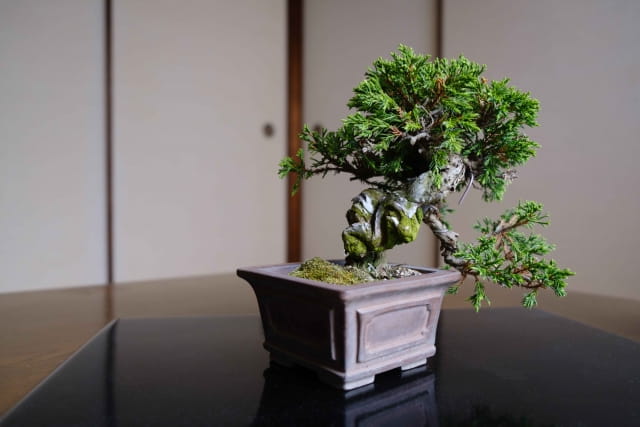
Bonsai is a traditional Japanese art form in which trees and plants are cultivated in containers (bon), and their branches, trunks, bark, and root systems are carefully shaped over many years to recreate and express natural landscapes.
The word is widely known internationally as "BONSAI," but it differs significantly from ordinary houseplants or potted plants.
- Houseplants: Plants are appreciated for their natural growth, flowers, or foliage.
- Bonsai: Through advanced techniques such as pruning and wiring, people recreate the appearance of ancient trees that have survived centuries of wind, snow, and harsh natural conditions, all in miniature form.
One of the most unique aspects of bonsai is that it is never truly finished.
A painting is completed when the artist lays down the brush. A sculpture is finished when the sculptor puts down the chisel.
Bonsai, however, consists of living trees.
Even as you care for them, they continue to grow, change with the seasons, and live on for decades or even centuries.
In this sense, bonsai can be described as an endless art form created collaboratively by humans and nature.
②Types of Bonsai
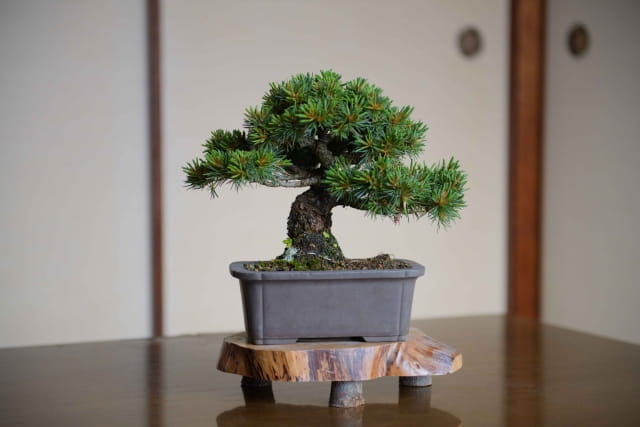
The world of bonsai is incredibly diverse. Bonsai can generally be divided into four major categories based on the type of plant used.
Understanding these categories allows you to appreciate the beauty of the changing seasons.
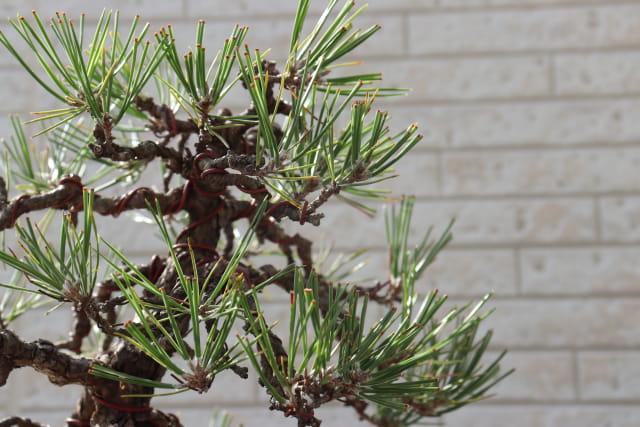
Conifer Bonsai (Shōhaku Bonsai)
This is the most classic and iconic category of bonsai.
- Common Species: Japanese Black Pine (Kuromatsu), Japanese White Pine (Goyōmatsu), Shimpaku Juniper, Japanese Cedar (Sugi)
- Characteristics: These evergreen trees remain green throughout the year. Pines and junipers in particular symbolise strength, sacredness, longevity, and endurance.
Highlights include rugged bark and dramatic deadwood features known as jin and shari.
Deciduous Bonsai (Zōki Bonsai)
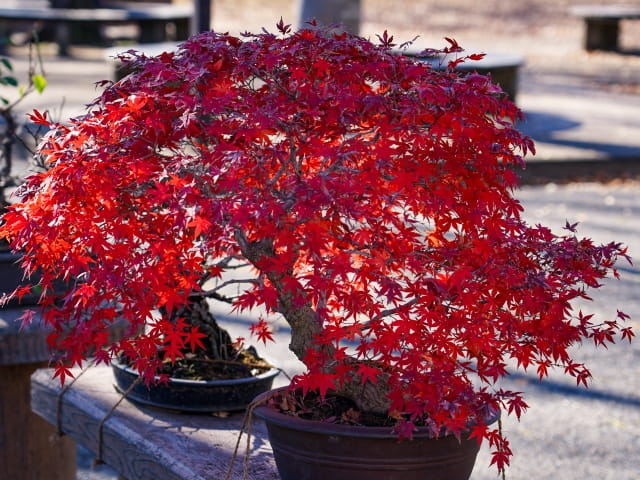
This category expresses the changing seasons most vividly.
- Common Species: Japanese Maple (Kaede), Momiji Maple, Japanese Zelkova (Keyaki), Japanese Beech (Buna)
- Characteristics: These trees showcase fresh green leaves in spring, deep foliage in summer, brilliant autumn colours, and delicate branch structures after leaf fall in winter, known as kanju. They offer a miniature representation of Japan’s seasonal beauty.
Flowering Bonsai (Hanamono Bonsai)
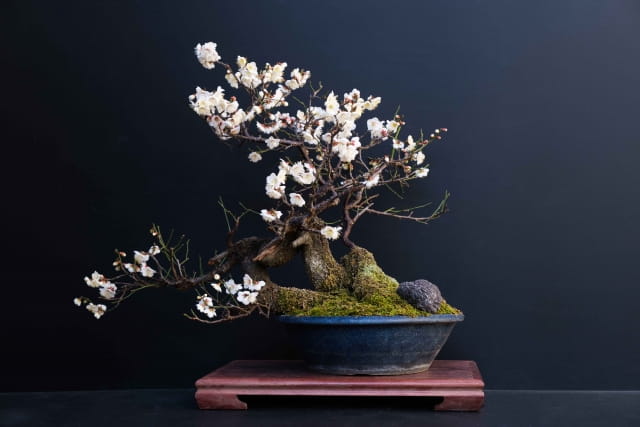
This category is valued primarily for its beautiful blossoms.
- Common Species: Cherry Blossom (Sakura), Satsuki Azalea, Plum (Ume), Wisteria (Fuji)
- Characteristics: From early spring through summer, spectacular displays of flowers bloom above small pots.
One of the greatest pleasures is being able to enjoy the beauty of cherry blossoms, one of Japan’s most iconic symbols of spring, up close and indoors.
Fruiting Bonsai (Mimono Bonsai)
This category focuses on ornamental fruits and berries.
- Common Species: Crabapple (Hime Ringo), Persimmon (Kaki), Chōjubai Quince, Pyracantha
- Characteristics: After flowering, small fruits develop and gradually turn red, yellow, or orange as autumn approaches.
These bonsai evoke feelings of abundance and the blessings of nature.
③The Philosophy and Appeal of Bonsai
Bonsai captivates people worldwide not only because of its visual beauty but also because of the uniquely Japanese philosophy that underlies it.
Three important aesthetic concepts are particularly relevant when appreciating bonsai.
Wabi-Sabi
Wabi-sabi is one of the defining concepts of Japanese aesthetics.
- wabi: Finding richness and beauty in simplicity and restraint.
- sabi: Appreciating the beauty that emerges through age, weathering, and the passage of time.
In bonsai, practitioners may intentionally create deadwood features or allow moss to grow naturally.
These elements express the beauty of ageing and the preciousness of time.
Rather than valuing perfection, this philosophy finds beauty in imperfection, wear, and history.
Shukkei (Miniaturised Landscapes)
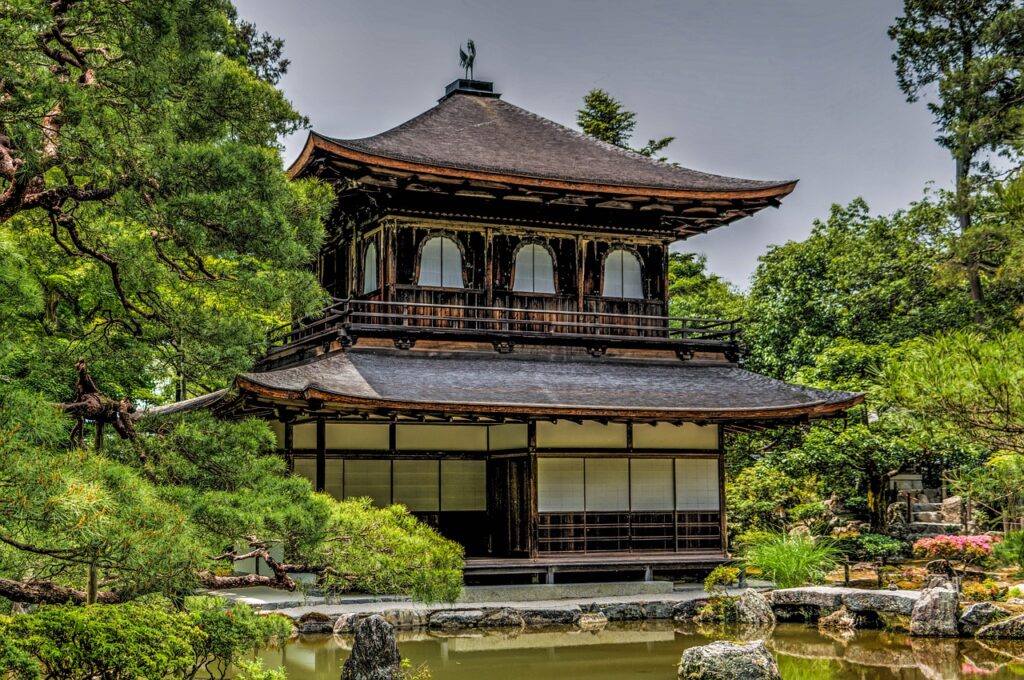
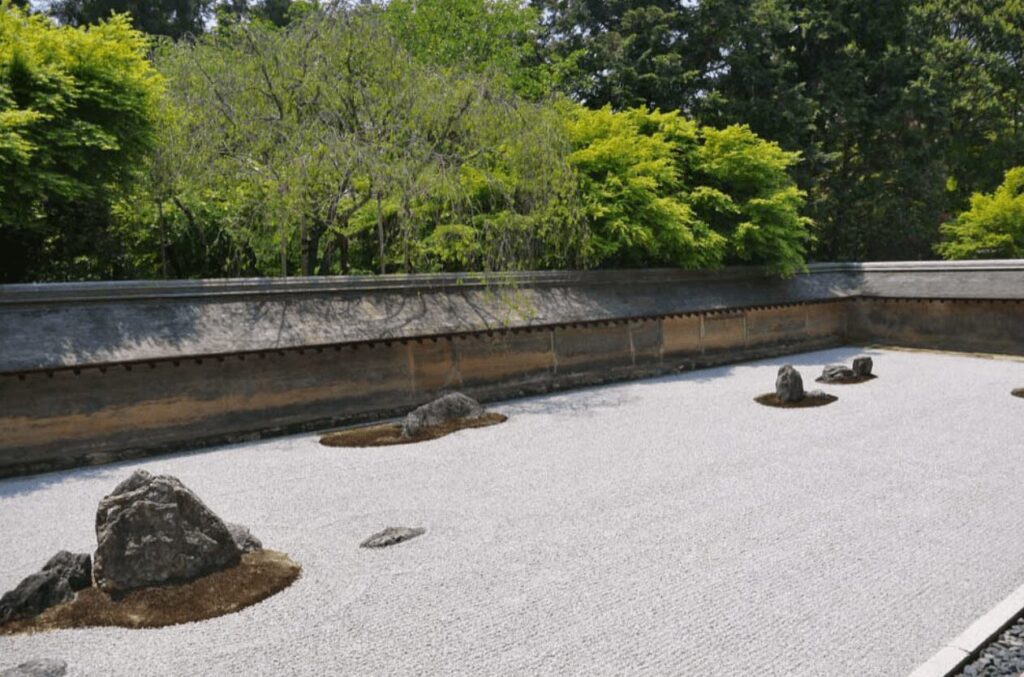
Shukkei refers to the concept of recreating vast natural scenery within a small space.
This idea also appears in Japanese gardens and dry landscape gardens (karesansui), but bonsai represents its ultimate expression.
While observing a small tree, viewers may imagine mist-covered mountains, remote forests, or dramatic coastal cliffs.
This ability to experience infinite expanses within a limited space is one of bonsai’s greatest attractions.
The Beauty of Asymmetry
In many Western artistic traditions, symmetry and geometric order are often regarded as ideals of beauty.
Examples include the formal gardens of the Palace of Versailles.
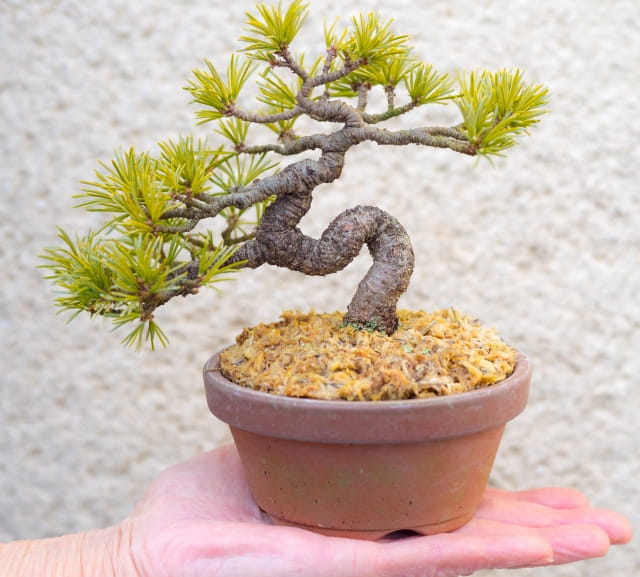
Japanese aesthetics, including bonsai, place greater value on asymmetry.
Trees in nature grow unevenly due to wind, sunlight, and environmental pressures.
This irregularity, unpredictability, and imperfect balance are seen as expressions of life's authentic beauty.
④The History of Bonsai
The origins of bonsai can be traced back to an ancient Chinese practice known as penjing.
This tradition is believed to have been introduced to Japan during the Heian period.
Illustrated scrolls from the Kamakura period clearly depict aristocrats displaying potted plants on shelves for appreciation.
During the Muromachi period, bonsai became deeply connected with the spirit of Zen Buddhism.
The elaborate decorative styles inherited from China gradually evolved into a distinctly Japanese form that emphasised simplicity and the expression of nature through a single tree.
Bonsai became enormously popular among ordinary people during the Edo period.
Everyone from shoguns to townspeople enjoyed the hobby, and horticultural techniques such as pruning advanced dramatically.
One famous example is a Japanese White Pine cherished by Tokugawa Iemitsu, the third Tokugawa shogun.
More than 500 years old, it is still carefully maintained by Imperial Household Agency gardeners within the Imperial Palace.
Following the Meiji period, bonsai was introduced internationally through world expositions and quickly attracted global attention.
Today, bonsai is recognised and appreciated around the world as one of Japan’s most iconic living art forms.
⑤How to Grow and Care for Bonsai
A bonsai cannot simply be watered and left alone.
Without proper care, it may either lose its artistic form or die.
Maintaining a healthy and beautiful bonsai requires daily attention.
Three major techniques are particularly important.
1. Watering
There is a famous saying among bonsai enthusiasts:
"Three years to learn watering."
This means that mastering proper watering takes years of experience.
Because bonsai pots contain very little soil, they dry out quickly.
Excessive watering, however, can cause root rot.
The basic principle is simple:
"When the surface soil becomes dry, water thoroughly until water drains from the bottom of the pot."
Determining exactly when to do this according to the season, weather, and condition of the tree is a skill developed through experience.
2. Pruning
Pruning involves removing unnecessary branches.
It serves two important purposes.
- To improve the tree’s silhouette and emphasise the beauty of the trunk.
- For health: To improve airflow and sunlight penetration, reducing the risk of disease and pests.
3. Wiring
Wiring is one of the most distinctive techniques in bonsai artistry.
Copper or aluminium wire is wrapped around branches and trunks, allowing them to be gradually bent into desired shapes.
This technique recreates the appearance of trees shaped by decades of wind, snow, and natural forces.
After several months or years, once the branch has set into its new position, the wire is removed.
⑥Where to See Bonsai in Japan
For visitors to Japan, several locations offer outstanding opportunities to appreciate authentic bonsai.
These destinations are especially popular among international travellers.
1. Omiya Bonsai Village & The Omiya Bonsai Art Museum (Saitama)
Often referred to as the "holy land" of bonsai.
Following the Great Kantō Earthquake of 1923, bonsai growers relocated from Tokyo to this area in search of ideal soil and water conditions, establishing a thriving bonsai community.
- The Omiya Bonsai Art Museum Official Website
- Highlights: Several historic bonsai nurseries can be explored throughout the village.
The Omiya Bonsai Art Museum, the world's first public bonsai museum, displays exceptional masterpieces with English explanations.
- Access: Ōmiya-Kōen Station, Toro Station. Approximately 30 to 40 minutes by train from Tokyo Station.
2. Shunkaen BONSAI Museum (Edogawa, Tokyo)
A private museum founded by renowned bonsai master Kunio Kobayashi.
- Shunkaen BONSAI Museum Official Website
- Highlights: More than 1,000 bonsai are displayed within a traditional Japanese garden, including many specimens that are several hundred years old.
The museum also offers bonsai workshops for international visitors, with English-language support available.
Participants can learn pruning and maintenance techniques firsthand.
- Access: Mizue Station (Toei Shinjuku Line)
⑦Summary
Bonsai is far more than decorative greenery.
It is a miniature universe containing the essence of Japanese culture: respect for nature, appreciation for the passage of time, and the imagination to discover infinite worlds within limited spaces.
Standing before a bonsai that has been nurtured and shaped by generations of caretakers over hundreds of years often evokes a profound sense of quiet reflection and awe.
If you have the opportunity to visit Japan, consider visiting a bonsai garden or museum.
Stand before a single small tree, close your eyes, and imagine the vast natural landscape it represents.
Doing so may deepen your understanding of Japanese culture in ways that words alone cannot express.
What are we?
We run Ninja Experience Cafe in Tokyo, Kyoto and Osaka, Japan.
Here you can immerse yourself in Japanese culture through experiencing ninja training.
Both adults and children are welcome to try their hand at defeating the ninja master inside the cafe.
The cafe is an indoor interactive zone, so it can be enjoyed even on rainy days.
If you are thinking "I want to be a real ninja too!” or interested in becoming a real ninja, please visit us.
Reservations can be made here.
Unauthorized copying and replication of the contents of this site, text and images are strictly prohibited.